


Global careers no longer begin with packing a suitcase—they begin with packing a mindset. Whether you’re a remote UX designer in Lagos working with a team in Berlin, or a Tanzanian-born repat navigating workplace life in London, your success hinges on more than talent. It hinges on Cultural Intelligence (CQ)—the meta-skill of the global professional.
This guide explores the depth and power of CQ, drawing from intercultural psychology, real-world examples, and personal transitions. It unpacks both the inner and outer work required to collaborate, belong, and thrive in complex cultural landscapes.
🧠 What is Cultural Intelligence?
Coined by Christopher Earley and Soon Ang, Cultural Intelligence is “a person’s capability to adapt as they interact with others from different cultural regions.” But CQ is more than a buzzword. It’s the practical wisdom to interpret, adjust, and connect across cultural lines—whether those lines are national, organisational, or generational.
Where IQ measures logic and EQ measures emotion, CQ measures the agility of your awareness, attitude, and action in unfamiliar or multicultural situations.
“In a world where you can be anywhere, the real power is being able to relate everywhere.”
🌱 The Three Dimensions of CQ: Knowledge, Skills, Attitudes
Cultural Intelligence isn’t one thing—it’s three interlocking capabilities that you can intentionally grow.
🧭 1. Knowledge – What You Understand
This is the cognitive layer—facts, customs, and context.
- Do you know how humour, status, or silence are used in a particular culture?
- Can you decode dress codes, meeting structures, and implicit norms?
👉 Ask:
- “What are the unspoken rules in this setting?”
- “What did I know about this culture before I arrived—and what was I wrong about?”
Knowledge includes understanding how small talk, business etiquette, or religious rhythms influence daily life.
🛠️ 2. Skills – What You Can Do
These are practical abilities that determine your effectiveness across cultures.
- Active Listening: Do you tune in for both words and meaning?
- Relationship Building: Can you forge trust beyond your cultural comfort zone?
- Team Collaboration: Do you adapt to group dynamics, respect hierarchies or informal networks?
👉 Especially in remote work, these skills are crucial:
- Reading tone in an email
- Managing asynchronous expectations
- Handling culturally diverse feedback loops
❤️ 3. Attitudes – How You Approach the World
This is the invisible foundation: your mindset.
- Are you curious or judgmental?
- Do you have patience with ambiguity?
- Are you open to rethinking your assumptions?
Core CQ attitudes include:
- Respect
- Flexibility
- Valuing difference
- Sensitivity to context
- A spirit of adventure
👉 Ask: “When was the last time I suspended judgment to ask ‘Why might it be this way?’”
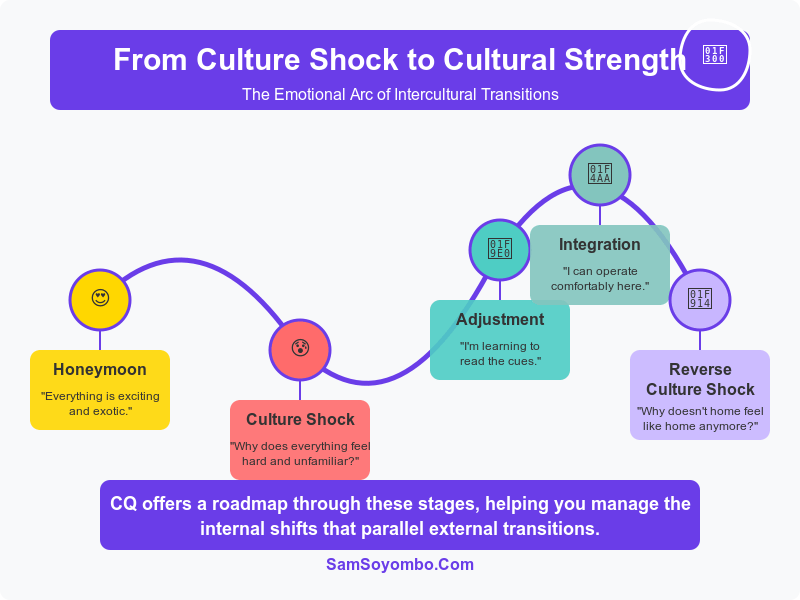
🧳 Expatriates & Remote Workers: CQ in Real Life
For professionals navigating new cultural environments, CQ is the lifeline. Let’s explore its real-world relevance.
✈️ For Expatriates:
- Understand the invisible rules of your host culture.
- Reflect on your own cultural anchors. What do you carry with you?
- Cultivate self-awareness: “How do I come across here?”
💻 For Remote Professionals:
- Be mindful of tone, timing, and tools. Emojis, silence, or delays may mean different things.
- Bridge the digital disconnection by proactively building rapport.
- Adapt collaboration styles—some cultures prefer structured task division; others thrive on fluid brainstorming.
🤝 The Role of Collaboration in Cultural Intelligence
Modern work is global by design, and collaboration is where CQ becomes visible.
According to recent research, successful collaboration now demands:
- Relationship Building: Forming authentic connections across cultural lines.
- Social Perceptiveness: Reading subtle signals—what’s not being said.
- Global and Cross-cultural Competence: Flexibly operating within different cultural logics.
📍Case in Point: Google x Levi’s — Project Jacquard
When Google’s tech team partnered with Levi’s fashion experts to create wearable smart denim, they weren’t just mixing disciplines—they were merging cultures. Tech’s agile pace met fashion’s seasonal cycles. Success wasn’t just technical—it was intercultural.
🧰 Building Your CQ: Practical Strategies
Developing CQ is like building a muscle. It takes time, reps, and intentional effort.
📚 1. Seek Knowledge
- Read fiction, watch films, or follow media from other cultures.
- Study frameworks like Hofstede’s Dimensions, The Culture Map, or The Intercultural Mind.
🧑🏾💼 2. Develop Intercultural Skills
- Practice active listening and suspend assumptions.
- Observe non-verbal cues and group dynamics.
- Be self-aware of how your communication might be received.
🧠 3. Cultivate Mindsets
- Embrace ambiguity: not everything has to be resolved instantly.
- Flex your openness: welcome the unexpected.
- Replace judgment with curiosity.
🪞 4. Reflect on Experiences
After a cross-cultural interaction, ask:
- What surprised me?
- What challenged my expectations?
- What might I do differently next time?
🗣️ 5. Seek Feedback
- Ask teammates: “How can I communicate more clearly across our cultures?”
- Be open to correction—CQ thrives in humility.
🌀 6. Lean into the “Oz Moment”
As Joseph Shaules puts it, being culturally lost is the start of transformation. Like Dorothy in Oz, don’t rush to return—explore with awe.
🎯 Conclusion: CQ Is Your Global Superpower
In a world where the next opportunity may be across a border—or a bandwidth—your success hinges not just on what you do, but how well you understand, connect, and adapt.
Cultural Intelligence is not a soft skill. It’s a strategic career advantage. For expatriates, remote workers, and global aspirants, CQ unlocks richer collaboration, deeper trust, and enduring success.
So the next time you feel “lost in translation,” remember: that moment isn’t a setback. It’s the doorway to your next level of growth.